
A baby food maker is a convenience appliance, not a requirement for starting solids. Many families use ordinary pots, blenders, or mashable foods instead. If you are comparing dedicated machines, focus on the steps you want to simplify: steaming, blending, reheating, batch size, and cleanup.
Start with the job you want the appliance to do
- Steam and blend in one container: fewer transfers, but check how the unit handles water, blending, and cleaning between stages.
- Separate steamer and blender: more flexible for family cooking, but adds equipment and cleanup.
- Blender or food processor only: may suit families that already steam food another way and want control over texture.
- Manual mashing: often enough for soft foods and small portions, with no specialized appliance to store.
No preparation method guarantees a particular nutritional result. Follow the food and appliance instructions, and choose textures and foods appropriate for your child’s development. For personalized feeding questions, ask your child’s clinician.
Compare specifications that affect everyday use
| Specification | What to look for |
|---|---|
| Batch capacity | Check separate steaming and blending capacities; liquid and solid limits may differ. |
| Workflow | Confirm whether the bowl must be turned, moved, or transferred between steaming and blending. |
| Cleaning | Read which parts are dishwasher-safe and how the blade, seals, reservoir, and water tank are cleaned. |
| Reheating/defrosting | Verify whether these are supported functions or require a separate appliance. |
| Texture control | Check whether the machine blends continuously, in pulses, or at set levels. You may still need to adjust texture manually. |
| Storage | Count included containers and verify their stated food-storage and heating use separately from the appliance bowl. |
| Footprint and cord | Measure your counter and storage space; use the manual’s electrical and placement instructions. |
Quick comparison: two one-step steam-and-blend machines

Baby Brezza One Step Baby Food Maker Deluxe
One-step steam and blend, 3.5-cup bowl, three modes, and dishwasher-safe bowl and blade per manufacturer.
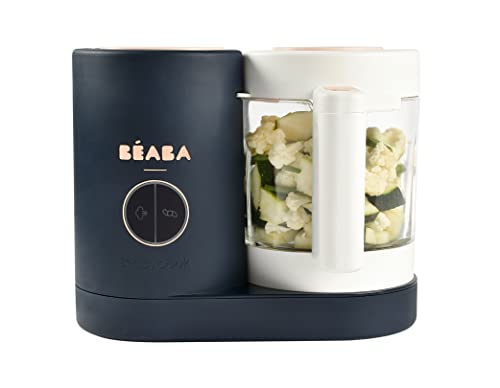
BÉABA Babycook Neo, 42 oz
Glass bowl and stainless-steel basket; verify the exact Neo model's current manual and parts before choosing.
As an Amazon Associate I earn from qualifying purchases. Check current listing/model variant before ordering. Baby Brezza specifications · BÉABA product information
Baby Brezza One Step Deluxe
- Steam and blend in one bowl
- Three operating modes
- Removable water reservoir
BÉABA Babycook Neo
- 42 oz glass bowl
- Stainless-steel basket
- Check exact local model and care instructions
*Prices are approximate and may change. Always check the live price on Amazon before buying.
A manufacturer-spec example
Philips' specification for the 4-in-1 Baby Food Maker, model SCF883/02, lists a 1-liter steaming capacity, 720-milliliter blending capacity for liquids, a 120-milliliter storage pot, and steam, blend, defrost, and reheat functions. Specifications differ by model and market; check the code on the unit and its current manual. Philips SCF883/02 specifications
Philips's specification for the 4-in-1 Baby Food Maker, model SCF883/02, lists a 1-liter steaming capacity, 720-milliliter blending capacity for liquids, a 120-milliliter storage pot, and steam, blend, defrost, and reheat functions. Specifications differ by model and market; check the code on the unit and its current manual. Philips SCF883/02 specifications
Which workflow fits your routine?
Baby Brezza emphasizes one-step steaming and blending. BÉABA Neo's larger stated bowl capacity may suit larger batches, but confirm exact regional model, included parts, and care instructions. Neither machine is necessary: a pot and separate blender may suit occasional small portions. BÉABA Neo
How the models differ
Baby Brezza lists automatic steam-and-blend, steam-only, and blend-only modes, a 3.5-cup bowl, removable reservoir, and dishwasher-safe bowl and blade. Neo is a glass-bowl/stainless-steel-basket design; check current regional instructions for exact functions, cleaning, and included pieces before buying. These comparisons use manufacturer materials, not hands-on testing.
Cleaning and food handling
Food residue can collect around blades, seals, and small parts. Follow the appliance manufacturer’s cleaning and descaling instructions, and do not assume every removable component is dishwasher-safe. Keep raw and cooked foods separate and use clean storage containers. For homemade baby food storage, see the AAP’s guidance on making baby food at home.
Who benefits from a dedicated baby food maker?
It may be useful if you regularly prepare batches and value an integrated steam-and-blend workflow. It may be unnecessary if you prepare small portions, already own a steamer and blender, or have limited storage. Compare the appliance’s actual functions with your routine before paying for bundled accessories.
For feeding bottles and preparation routines, see our bottle-feeding guide for breastfed babies. This guide does not claim hands-on testing; compare listed manufacturer specifications and confirm the current model, package, and instructions before purchase.
Frequently asked questions
Do I need a baby food maker?
No. It is an optional convenience appliance. Many foods can be prepared with ordinary kitchen tools, as long as they are prepared and stored safely.
Can a baby food maker replace a blender?
Some models blend, but capacities, blade designs, and intended uses differ. Check the manual for the foods, quantities, and operating limits supported by that exact model.
Are all parts dishwasher-safe?
No. Confirm the care instructions for each removable part, especially blades, seals, water tanks, and heating components.
Can I use one machine to steam and blend without transferring food?
Some combination appliances are designed for that sequence. Check the exact model’s manual: the workflow and capacity can differ across versions.